
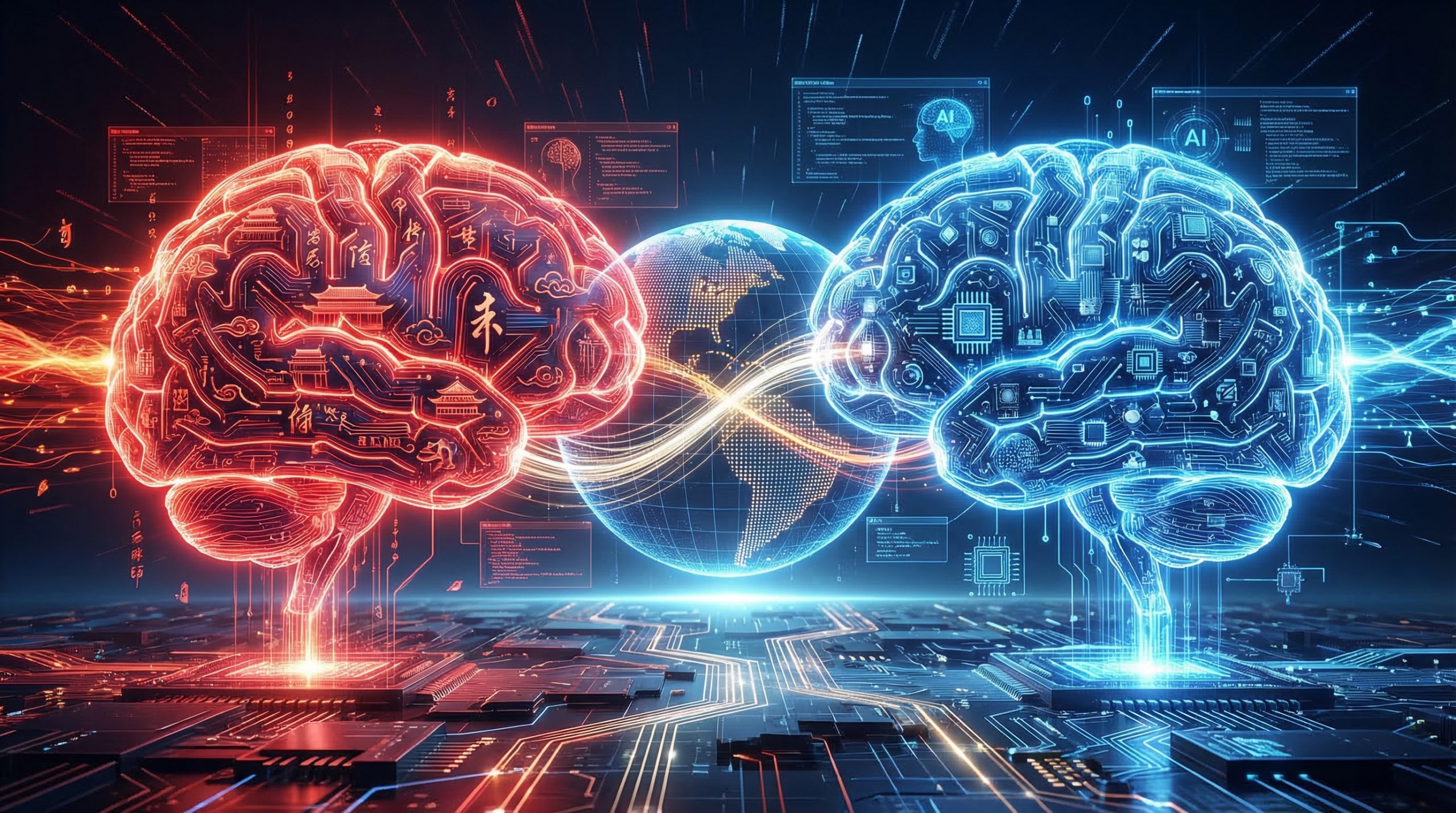
The global competition to lead the next generation of artificial intelligence (AI) is shifting into high gear, with both the United States and China investing heavily in research, infrastructure and national strategy to come out on top. The rapidly accelerating race now goes well beyond simple bragging rights — it carries major economic, military and geopolitical implications for the decade ahead.
This rivalry isn’t just about who builds the smartest AI models — it’s about who controls the underlying technology stack, shapes global standards, and harnesses AI to power economic and strategic advantage. These developments were highlighted by experts and policymakers in recent coverage of the AI landscape.
Two Strategies, One Race
Although the U.S. has long been the leader in cutting-edge AI research, Chinese tech companies and state-backed initiatives are narrowing the gap through aggressive deployment and integration of AI across industry. In the United States, frontier AI models and hardware innovation remain strong, backed by deep capital markets and major cloud and chip investments. Meanwhile, China emphasizes widespread adoption, energy capacity expansion and practical deployment of AI technologies across manufacturing, logistics and services.
These differing strategies reflect deeper trends:
- The U.S. excels in high-end models, heavyweight research and frontier hardware.
- China is rapidly scaling AI within its economy, making AI tools more accessible and integrated into everyday systems.
- The outcome will influence not only which nation leads in AI, but also how the technology will be used around the world — in business, government services and even national defense.
Economic and Strategic Stakes
Leadership in AI offers substantial rewards. Governments and private companies alike view advanced AI as critical for economic growth, global competitiveness, and national security. AI innovation could redefine entire industries — from healthcare, education and transportation to defense systems and cyber warfare capabilities.
U.S. tech companies benefit from deep investment ecosystems and world-class research institutions, but face challenges such as energy infrastructure constraints and regulatory uncertainty that could slow large-scale AI training and deployment. China, meanwhile, continues to rapidly expand its data-center power capacity, aiming to support vast AI networks at lower cost and with strong state coordination. Despite trailing in some advanced hardware capabilities, Chinese AI systems have made striking progress in real-world deployment and open-source development.
More Than Just Two Players
Experts note that the U.S.–China AI competition is only part of a broader global story. Other nations, including India and members of the European Union, are pushing for a “third way” in AI development — one focused on open-source models, sovereign AI ecosystems and cooperation among democratic states. Such efforts reflect growing awareness that global AI leadership might not be won by a single superpower alone.
The Big Picture
The AI race of 2026 is not a sprint to a single finish line — it’s an evolving contest with multiple fronts, from chips and data centers to natural language models and autonomous systems. Whether one country emerges definitively ahead remains uncertain, but the competition itself is reshaping global innovation, investment flows, and international relations.
For businesses, policymakers and ordinary citizens alike, that means one thing: AI will play a defining role in economic power and global influence in the years ahead — and where you live may shape how you experience that future.