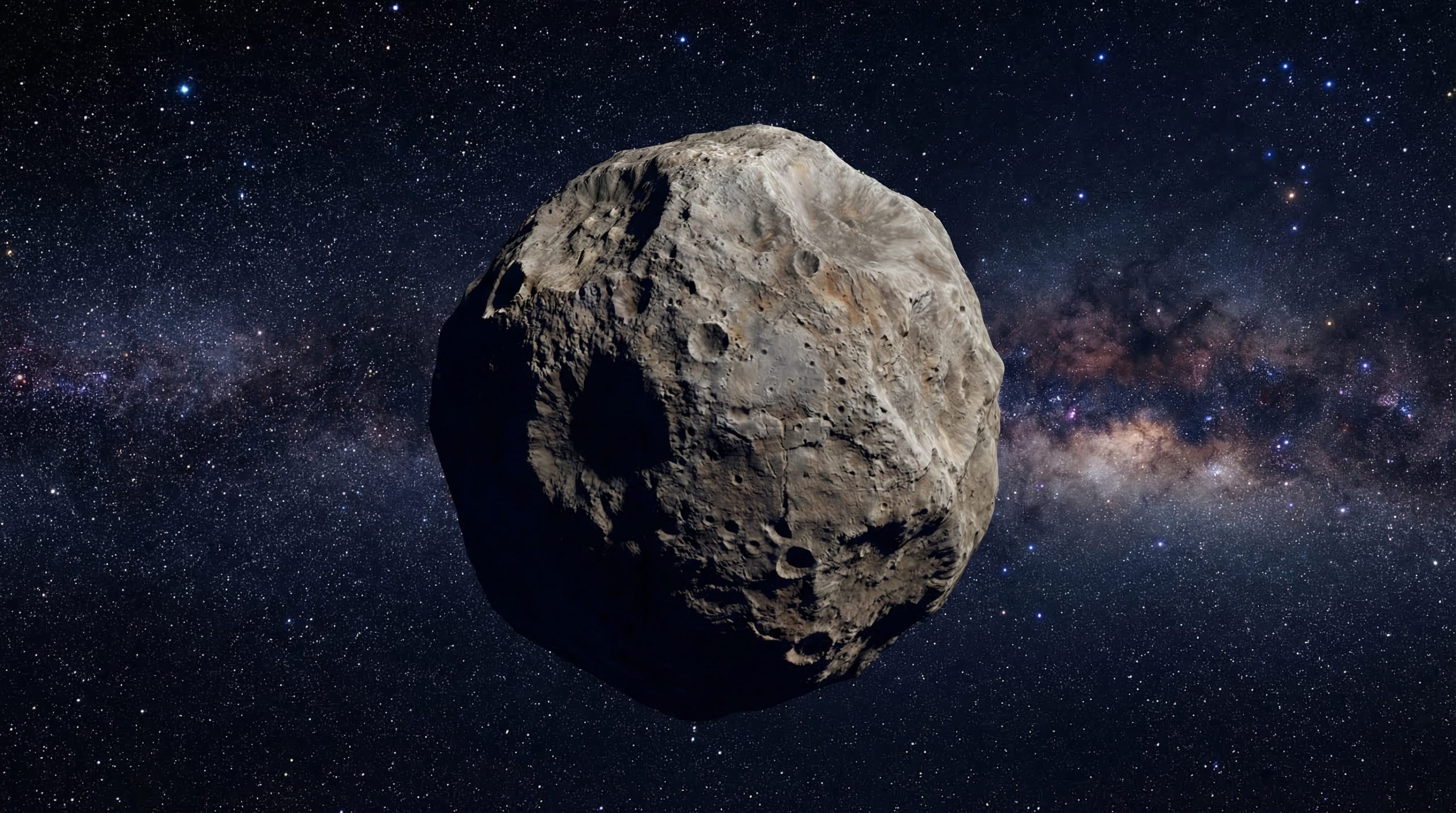
Not every astronomical event draws attention through brightness or visual drama. Some become worth watching because they place a faint object in its most favorable observing position of the year. That is the case with Asteroid 20 Massalia, which reaches opposition on March 21, 2026, at 16:46 UTC.
In astronomy, opposition is the moment when an object appears on the opposite side of the sky from the Sun as seen from Earth. This geometry places the object highest in the sky around local midnight, making it the most favorable time for observation during its yearly cycle. According to In The Sky, 20 Massalia will be located in the constellation Virgo and will remain well placed for much of the night around the event.
The most notable aspect of this opposition is the combination of distance and brightness. In The Sky reports that 20 Massalia comes to within about 1.291 AU of Earth during this period and brightens to around magnitude 9.0. That means it is not a target for naked eye viewing, but it does make this the most practical observing window of the year for those using optical equipment.
The observing reality is important to state clearly. At around magnitude 9.0, this asteroid is far too faint to become a mass audience sky event. In The Sky describes it as observable with a four inch telescope under suitable conditions. In other words, this is an event for prepared observers, not a broad public spectacle.
At the moment of opposition, positional data published by In The Sky places 20 Massalia at approximately Right Ascension 12h01m30s and Declination 0°45′ south, confirming its location in Virgo. For observers, that means finding the asteroid will depend heavily on star charts, ephemerides, and the ability to track a faint point of light moving across the background stars, rather than waiting for any striking visual signal.
From a scientific standpoint, 20 Massalia is not a minor object in asteroid research. NASA JPL classifies it as a main belt asteroid and lists its rotation period at about 8.098 hours. That makes Massalia a familiar target in studies of the dynamics and physical properties of small bodies in the Solar System.
Scientific interest in 20 Massalia has also grown following recent reports of molecular water signatures on its surface. A document archived in NASA’s system identifies 20 Massalia as one of the asteroids reported to show evidence of molecular water, expanding its scientific value beyond its role as a seasonal observing target. That finding does not make the asteroid any brighter in the eyepiece in March 2026, but it does make this opposition more noteworthy from both an editorial and scientific perspective.
By international publishing standards, the key reference point for the event is March 21, 2026, at 16:46 UTC. That is the clearest and most consistent way to present the timing for a global audience. In editorial terms, Asteroid 20 Massalia at opposition is best understood as a timely observing window for a faint but meaningful object, rather than a dramatic public sky event.