China Discovers Previously Unknown “Spiny Dragon” Dinosaur
(NLDO) — The “spiny dragon,” Haolong dongi, lived in northeastern China approximately 125 million years ago.
Based on a fossil skeleton unearthed in northeastern China, an international research team from China, Belgium, France, and the United States—led by the French National Centre for Scientific Research (CNRS)—has identified a completely new dinosaur species named Haolong dongi. The name “Haolong” translates to “spiny dragon.”
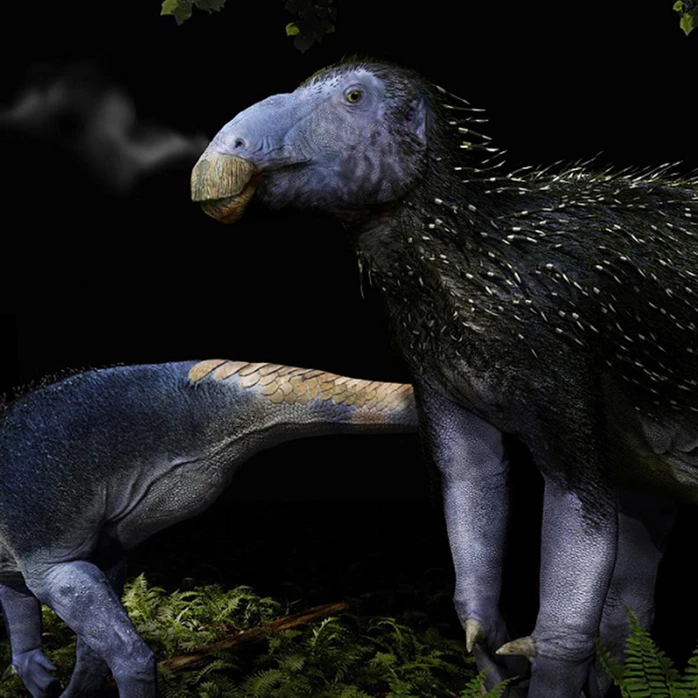
- Spiny dragon Haolong dongi. Illustration: Fabio Manucci
Writing in the scientific journal Nature Ecology & Evolution, the authors explained that the distinctive name derives from its skin, which was covered with hollow, spine-like structures resembling porcupine quills—a feature never before documented in known dinosaur species.
According to SciTech Daily, the species was identified from a single specimen: a nearly complete juvenile skeleton measuring 2.45 meters in length.
It belongs to a major group of large herbivorous dinosaurs known as Iguanodontia, characterized by beak-like mouths and strong hind limbs.
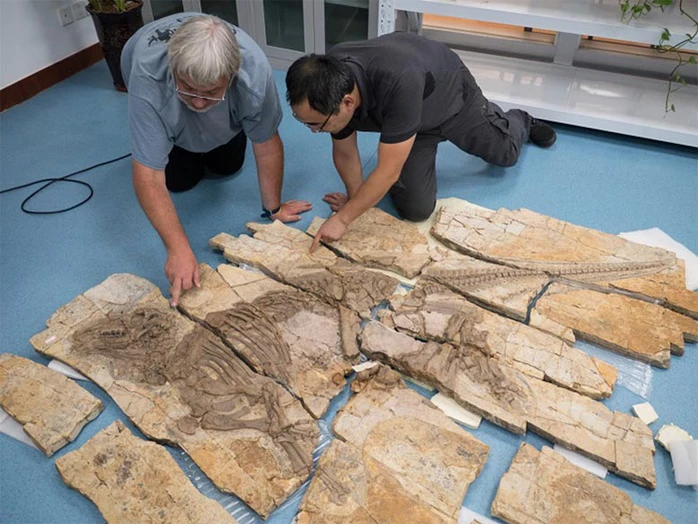
- Researchers examine the Haolong dongi fossil specimen. Photo: Thierry Hubin
Haolong dongi was a plant-eating dinosaur. During the Early Cretaceous period—the time in which it lived—the ecosystem included many small carnivorous dinosaurs that may have preyed on young herbivores. As such, the hollow spines may have served as a defensive adaptation.
Additionally, the spines may have helped regulate body temperature, as structures that increase surface area can assist in dissipating excess heat or retaining warmth.
Another hypothesis is that the spines functioned as sensory aids, helping the animal detect contact or movement in its surroundings more effectively.
Scientists remain uncertain how large the spiny dragon would have grown as an adult and whether it retained these distinctive spines throughout its life.